The wheels are turning — sweeps & brickwork across the shiretownInsured • One Crew, Every Season • Mon–Sat 7–7Call (339) 213-9161
East Dedham • Riverdale • Greenlodge • The Manor
America Learned Fine Fired Clay From This Town. Your Flue Is Fired Clay. We Keep It True.
A chimney is pottery standing in the weather — clay tile, fired brick, and mortar holding the set. Dedham of all places deserves that work done right: flues swept to the bare tile, joints repacked full, caps seated fast, and the phone answered by the mason himself, Monday through Saturday, seven to seven.
Eight Wares on the Shelf, Thrown by the Same Hands
No piece here leaves the shed half-done. The mason who reads your chimney throws the job himself, and the figure named at the wheel is the figure stamped at the kiln door.
Soot Pulled to Bare Clay
The brush goes the full height and comes back again until the tile shows its own color — and every scrap it frees travels down a sealed draft into a drum, never sideways into the room.
Every piece of work begins at the free reading — and when a purchase, a policy or a draft with no explanation needs pictures that move, the camera rides the flue and brings the film home.
A top that winter has thrown off center comes apart to the last course still true, then rises again the way a good pot rises — centered, bonded through, and crowned to cast its water wide.
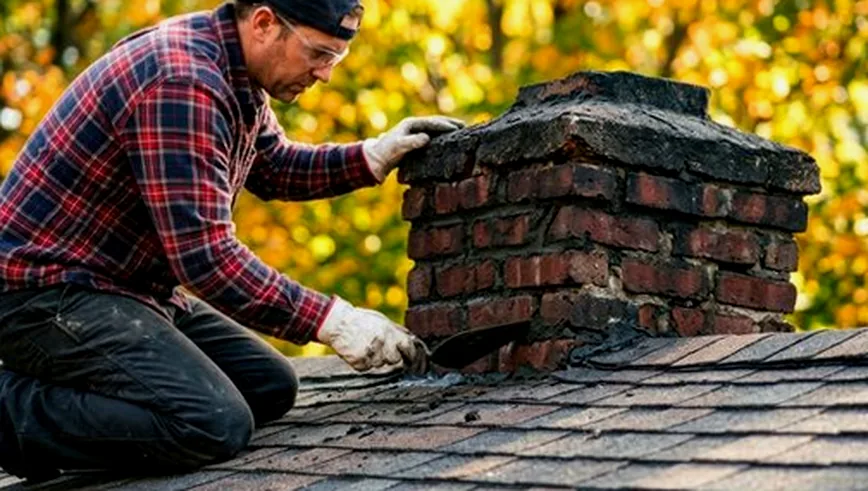
Freeze and thaw crumble mortar the way a bad firing crazes a glaze. The failed depth gets raked square, fresh mortar driven to the back of every joint, the face tooled tight — mixed softer than the brick, matched to its age.
A kiln is roofed for the same reason a flue should be. Heavy stainless caps go down on anchors set in sound masonry, over crowns coated or recast until they turn water like fresh glaze.
A tea-colored bloom on the ceiling is water publishing its route. We trace it with a controlled hose test until the failed seam owns up, then remake that junction so the verdict never needs appealing.
When the original tile has cracked past saving, or a furnace swap left the flue mis-sized for its new appliance, one welded stainless path goes in — gauged to the unit below, insulated where its listing requires.
A firebox is the one vessel in the house asked to hold fire nightly. Spent back walls come out for true firebrick in refractory bedding, throats get faired to pull clean, and gas sets go in level and square.
Spotted one of the seven at home?Phone it in while it's still a hairline. You'll get the mason's plain opinion — bide until a slack week, or jump the queue tomorrow — and he'll stand by either answer without a sales pitch riding on it.
The Firing
Every Job Goes Through the Kiln in the Same Four Stages
A firing schedule exists so nothing is left to mood — same stages, same order, and that's why the figures come out true.
1
The Wedging
Call between seven and seven, any day but Sunday. The mason takes the shape of the problem and sets a day.
2
The Kiln Reading
Firebox to cap, every surface inspected in order, the verdict spoken plainly — and no meter running anywhere.
3
Cones on the Card
What needs work gets a figure apiece, pressing jobs ranked over patient ones — and once set, a figure keeps its shape.
4
The Cool-Down
The work finished to standard, the house handed back spotless, and the warranty signed before the truck pulls out.
Before the Kilns of Winter Light
Come the First Cold Night, Every Hearth in the Shiretown Fires at Once. Book Ahead of the Rush.
That first bitter evening lights half the town's fireplaces together, and the weeks after it are spoken for before they arrive. A call in the gentle months puts your sweeping, your cap and your pointing on the schedule at a potter's pace — unhurried, exact, and on the day you actually wanted.
Work that survived the firing — sweeps, caps, stainless and courses newly laid, from the villages and over the line.
Crown brushwork — East DedhamThe hose run up and overTop finished out — RiverdaleCap mounted, town past the ridgeFace cleaned for repackingHearth sheeted, seal drawingGas set out for its checkingInsert squared for its steelCourses bonded — GreenlodgeSteel placed — West Roxbury
The Fire Map
From Bussey St Through the Villages and Over the City Line
The shed keeps 02026 warm first; the rounds then work the villages and cross into the city's southwest corner and the towns below.
East Dedham
Riverdale
Greenlodge
Ashcroft
The Manor
Precinct One
Hyde Park
Readville
West Roxbury
Roslindale
Sharon
Stoughton
Past the map's rim? Call (339) 213-9161 — enough work in one spot has always rolled the truck farther.
Asked at the Cool-Down
Dedham Chimney Questions, Answered While the Kiln Cools
You'll climb my roof, read my whole flue, and bill me nothing. Say that once more?
Gladly, because it keeps surprising people. The visit inspects the firebox, the damper and the smoke chamber from inside the room, examines the flue over its full height, and finishes at the top of the stack with the crown, the cap, its screen and the flashing courses. Everything found gets spoken aloud and ranked — what needs doing now, what can season a while, what's sound — before the truck door closes. None of that carries a price. The ledger opens in two cases only: the fired record, which is the reading pressed onto paper with photos and an unwandering price per repair at $149, made strictly because you asked, and any repair you commission after hearing the verdict. Walkaways with nothing owed happen all the time, and they're fine by us.
Called on a Sunday and got the recording. Where does my message land?
Onto the morning's wedging table. When the line opens at seven the next working day, the machine's messages get worked first, in the order they arrived, before any new call is taken — and whatever Sunday collected is Monday's first business. A mason personally holds this phone from seven to seven, Monday through Saturday; evenings and Sundays belong to the recording, and we'd rather print that than polish it. Over everything stands the kiln rule: flame where it shouldn't be, smoke pushing into the house, or a CO alarm singing means everyone outside and 911 dialed before our number is even found.
Our 1790s colonial has one huge center chimney carrying four fireplaces. Can you work on it without ruining what makes it original?
That center mass is the house's keel, and it gets treated that way. A 1790s chimney was laid in lime mortar, soft-fired brick and patience — hit it with modern Portland and a grinder run wild and you trade a working antique for a cracked one. Our approach runs gentler: mortar analysis first so the repair matches the original in softness, hand-raking where power tools would bruise, flues mapped one by one since colonial stacks often carry three or four with thin withes between, and any lining built so it can be taken out again — reversibility is the standard for old work. Most of these great chimneys need less than their owners fear; the trick is a mason who can tell the settling of two centuries from the damage of one bad decade. The reading sorts that out at no cost.
Birds are chattering inside the chimney every June. Can you just clean them out?
Not in June, and that's federal law rather than squeamishness. That chatter is almost certainly chimney swifts — little cigar-shaped birds that glue stick nests to flue walls — and they're protected under the Migratory Bird Treaty Act: nests with eggs or young can't be removed, by us or anyone. The good news is the stay is short; broods fledge and leave by late summer. The right sequence is to live with the roommates until they go, then have the flue swept and inspected, then close the door behind them — a cap with proper screening, sized so it guards the flue without choking the draft. After that the colony moves elsewhere and the problem is history. Call when the noise stops and we'll handle the sweep and the cap in one visit.
Honest question: a man slips up there, whose insurance carries it?
Ours does, entirely. The men who climb for this company are on its payroll in January as surely as October — no borrowed labor when the season heats up — and behind them sit liability insurance and workers' compensation that are current today, not framed from some earlier year. If something went wrong on your roof, the claim would travel to our carrier and stop there; your homeowner's policy wouldn't hear about it. Anyone who wants the certificate before the first boot hits the ladder only has to say so at booking — it arrives by email ahead of us.
Be straight with me about the soot. What does sweeping do to my living room?
Cleaner than a glaze firing, and we treat it with the same respect. The room gets dressed before any tool enters: canvas runners on the floor path, the fireplace opening sealed under taped sheeting, and a vacuum with true HEPA filtration pulling a steady draw into the firebox from start to finish — so everything the brush frees is carried down and captured, never outward. The rods and brushes do all their work behind that seal. A common single flue runs near the hour mark, and the test we hold ourselves to at the end is blunt: run a white cloth along the mantel, and the only thing changed in that room should be the inside of the chimney.
We burn maybe a cord a winter, no stove. Surely that earns a pass on the yearly visit?
Once a year, and the modest burning is exactly why. A cord-a-winter fireplace builds creosote slowly, but slow is not never, and the deposits that do form get long undisturbed stretches in which to harden toward the glassy stage that light brushing can't touch. Meanwhile the parts of the chimney that don't care about your logbook — crown, cap, flashing, liner joints — weather at their own pace through every season you don't burn at all. The annual visit reads the whole instrument, catches the slow builders early, and most years it ends with a clean bill and a handshake. Skip three in a row and the odds start writing their own schedule.
We're in Roslindale, city side of the line. Does your truck cross into Boston?
Several times a week, city stickers and all. The shed sits on Bussey St in East Dedham, a stone's throw from the Boston line, and the regular rounds cover Dedham's own villages — East Dedham, Riverdale, Greenlodge, Ashcroft, the Manor, Precinct One — then cross into Hyde Park, Readville, West Roxbury and Roslindale, and run south to Sharon and Stoughton. Outside that ring, tell the mason what the job is: enough work in one place has always been reason to roll farther.
The Bussey St Saleroom
Ring Once and You Have the Maker Himself.
There's no counter help to get past. The man who answers sizes work for a living and keeps the calendar within arm's reach.
The kiln shed105 Bussey St, Suite B Dedham, MA 02026
The roundsThe villages, the city's corner & the towns south
When the wheel turns
Mon – Sat
The mason answers straight through, seven a.m. clear to seven p.m.
Sunday
The kiln rests — the recording sets you first on Monday's wedging table
The maker's own hand on this line
Describe It Rough. The Shaping Is Our Job.
The crack you noticed shoveling the walk, the cap that hums in a northeast blow, the black dust that keeps returning to the mantel — say it in kitchen words. When the call ends you'll know how urgent it truly is, roughly what it runs, and which day the truck comes.